

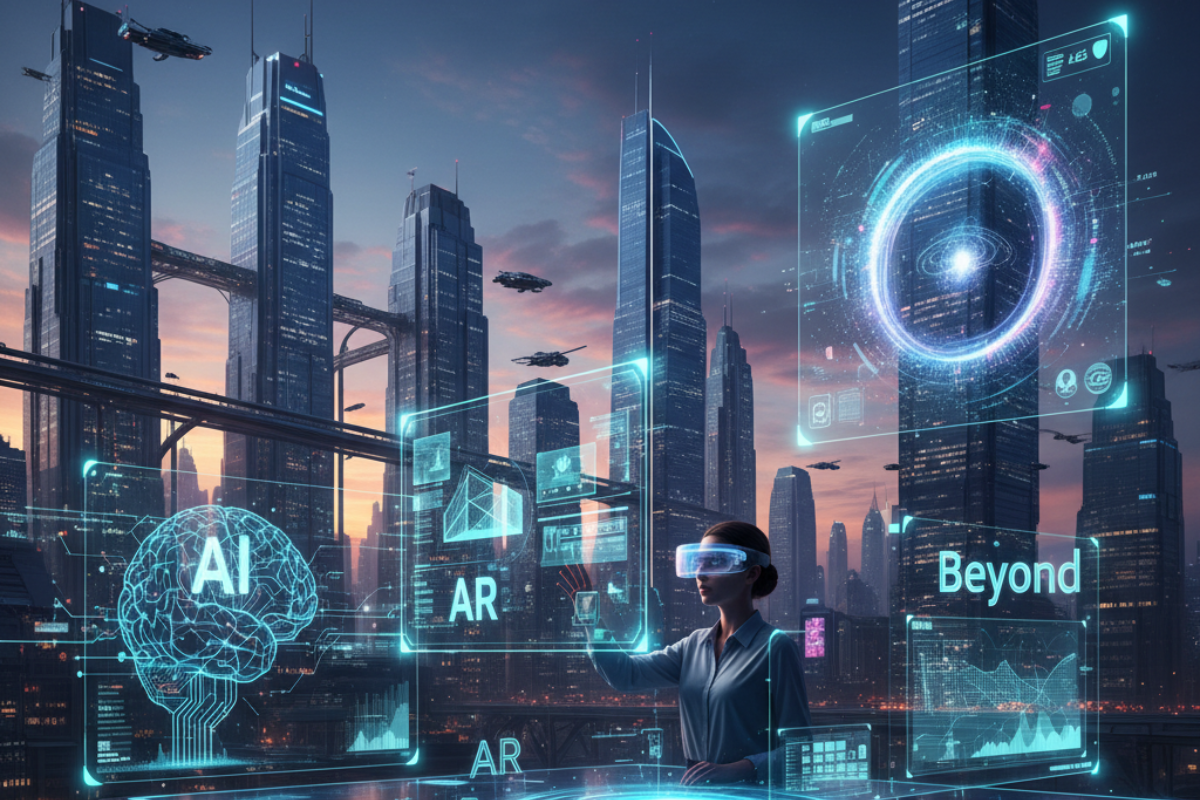
Technology has always been a key driver of human progress. From the invention of the wheel to the rise of the internet, every significant innovation has transformed the way we live, work, and interact. Today, we are witnessing a similar revolution with Artificial Intelligence (AI), Augmented Reality (AR), and other emerging technologies that are reshaping industries, economies, and societies at an unprecedented pace.
In this article, we’ll explore how these technologies are evolving, their impact on various sectors, and why understanding them is no longer optional but essential.
Understanding AI, AR, and Emerging Technologies
Before diving deep into the future, it’s crucial to understand what these technologies are and how they differ from traditional tools.
Artificial Intelligence (AI) refers to computer systems designed to mimic human intelligence. It can process large amounts of data, recognize patterns, make decisions, and even learn from experience. AI is not a single technology but a combination of machine learning, neural networks, natural language processing, and robotics.
Augmented Reality (AR) overlays digital information on the real world, enhancing the way we perceive and interact with our environment. Unlike Virtual Reality (VR), which creates a completely immersive digital world, AR combines real-world experiences with virtual elements.
Emerging technologies extend beyond AI and AR, including blockchain, quantum computing, 5G, and the Internet of Things (IoT). Together, these innovations are shaping a new era where digital and physical worlds converge seamlessly.
Quick Information Table: AI, AR & Beyond
Here’s a basic table summarizing the key aspects of AI, AR, and other emerging technologies:
| Technology | Definition | Key Features | Applications | Future Potential |
|---|---|---|---|---|
| Artificial Intelligence (AI) | Machines simulating human intelligence | Machine learning, neural networks, NLP, robotics | Healthcare, finance, autonomous vehicles, customer service | Smarter cities, predictive analytics, advanced automation |
| Augmented Reality (AR) | Overlaying digital content on real-world views | AR glasses, mobile AR apps, interactive interfaces | Gaming, retail, education, healthcare | Enhanced learning, immersive shopping, industrial training |
| Virtual Reality (VR) | Fully immersive digital environments | VR headsets, 360° content, motion tracking | Gaming, training, simulation, entertainment | Realistic simulations, virtual workplaces, digital tourism |
| Blockchain | Decentralized, secure digital ledger | Cryptography, smart contracts, transparency | Finance, supply chain, voting systems | Secure transactions, decentralized applications |
| Quantum Computing | Advanced computation using quantum bits | Superposition, entanglement, quantum algorithms | Drug discovery, logistics, cryptography | Solving previously impossible problems, AI acceleration |
| Internet of Things (IoT) | Network of connected devices exchanging data | Sensors, smart devices, cloud integration | Smart homes, industrial automation, wearable tech | Efficient cities, predictive maintenance, personalized healthcare |
| 5G Technology | Next-generation mobile network providing high-speed connectivity | Low latency, high bandwidth, network slicing | Autonomous vehicles, smart cities, AR/VR streaming | Global connectivity, real-time applications, IoT expansion |
| Robotics | Machines performing tasks autonomously or semi-autonomously | Automation, AI integration, mechanical precision | Manufacturing, logistics, healthcare, agriculture | Human-robot collaboration, autonomous workplaces |
This table highlights the essentials of each technology and how they are interlinked in creating a future that’s smarter, faster, and more interconnected.
How AI is Transforming Industries

AI is no longer a futuristic concept; it is actively reshaping multiple sectors. Some of the most notable impacts include:
-
Healthcare
AI-driven diagnostics, robotic surgeries, and personalized medicine are revolutionizing healthcare. Algorithms can analyze medical images faster and more accurately than humans, while predictive analytics can identify potential health risks before they become serious problems. -
Finance
AI enhances fraud detection, automates trading, and improves customer experiences. Algorithms monitor transactions in real-time, detect anomalies, and offer personalized financial advice. -
Education
AI-powered learning platforms personalize educational content based on student performance. Virtual tutors, adaptive testing, and AI chatbots make learning more interactive and effective. -
Retail
AI-driven recommendations, chatbots, and inventory management systems are reshaping the retail landscape. Predictive analytics helps companies forecast demand and optimize supply chains. -
Transportation
Self-driving cars and smart traffic management systems are made possible by AI, improving road safety and reducing congestion.
The Rise of Augmented Reality
AR is transforming the way we experience the world by blending digital content with physical environments. Here’s how AR is changing various sectors:
-
Gaming and Entertainment
AR games and immersive experiences bring players into interactive worlds, creating new forms of engagement. -
Retail
AR allows consumers to visualize products before purchasing, such as trying on clothes virtually or previewing furniture in their homes. -
Education and Training
Interactive AR lessons make complex subjects more understandable, while AR simulations provide safe and realistic training for professionals. -
Healthcare
AR assists surgeons in visualizing internal organs during operations, improving precision and outcomes.
Emerging Technologies Beyond AI and AR
While AI and AR are prominent, several other technologies are shaping the future:
-
Blockchain ensures secure and transparent digital transactions, impacting finance, supply chains, and governance.
-
Quantum Computing promises exponential increases in computational power, potentially solving problems that classical computers cannot.
-
IoT connects devices and systems to optimize processes in homes, cities, and industries.
-
5G Technology offers ultra-fast internet, enabling real-time applications like autonomous vehicles, remote surgeries, and AR/VR experiences.
-
Robotics complements AI to automate tasks, enhance productivity, and support human labor.
Together, these technologies form an ecosystem where digital intelligence and physical reality converge, creating opportunities that were once considered science fiction.
Challenges and Ethical Considerations
As exciting as these technologies are, they also come with challenges:
-
Privacy Concerns
AI and IoT rely on vast amounts of data, raising concerns about data privacy and security. -
Job Displacement
Automation and robotics may replace certain jobs, requiring reskilling and workforce adaptation. -
Ethical AI
AI systems must be designed to avoid biases, discrimination, and unintended consequences. -
Digital Divide
Access to advanced technologies remains uneven, potentially widening the gap between developed and developing regions.
Addressing these challenges is essential to ensure that technology benefits everyone and minimizes harm.
The Future Outlook
The future of technology is interconnected, intelligent, and immersive. Some key trends to watch include:
-
AI-Powered Creativity: AI is increasingly being used to create art, music, and even literature, blurring the lines between human and machine creativity.
-
AR in Everyday Life: AR will move beyond entertainment to become a routine part of shopping, learning, and professional tasks.
-
Hyperconnected Smart Cities: IoT, AI, and 5G will create cities that are more efficient, sustainable, and responsive to citizens’ needs.
-
Quantum Leap in Computing: Quantum computers may revolutionize sectors such as pharmaceuticals, cryptography, and logistics.
-
Human-Machine Collaboration: Robotics and AI will increasingly work alongside humans, enhancing productivity while allowing people to focus on more strategic tasks.
The pace of technological evolution is accelerating, and staying informed is crucial for businesses, professionals, and individuals alike.
Conclusion
AI, AR, and emerging technologies are no longer optional topics for discussion—they are transformative forces shaping our present and future. Understanding these technologies, their applications, and the ethical implications is essential for navigating a world that is becoming increasingly digital and interconnected.
Whether you’re a business leader, student, or technology enthusiast, embracing these innovations will ensure that you are prepared for a future full of opportunities and challenges alike.
